Your Life
STAYING UP TO SPEED
The rules of the road are always changing. Here’s the latest to keep you at ease behind the wheel
Those who have driven for decades may not always realize that some of their habits may have become outdated. And that can put their safety at risk. Here are some updated tips.
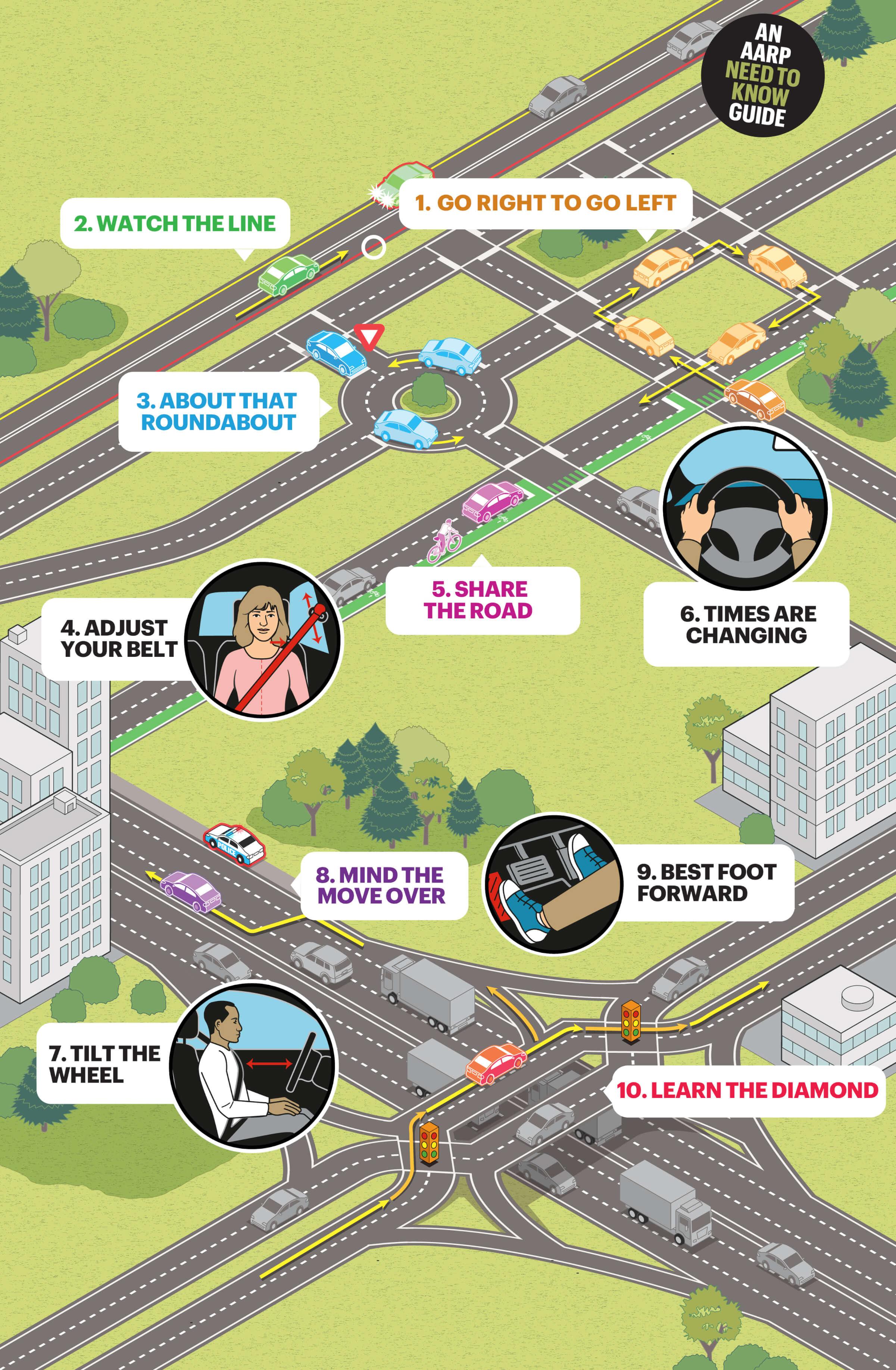
1. GO RIGHT TO GO LEFT
Turning left across oncoming traffic can be stressful. There’s no shame in avoiding it. Remember, three right turns can equal a left. At an intersection with a traffic light, drive a block farther, take a right, then two more and you should be facing in the desired direction. Safely cross the intersection on a green light.
2. WATCH THE LINE
Oncoming headlights too bright? To keep from getting blinded, look to the right of the road and follow the edge line there. In general, driving in the right lane on multilane roads can reduce exposure to the brightest oncoming headlights.
3. ABOUT THAT ROUNDABOUT
Traffic circles have become more common because they reduce intersection crashes, says Wen Hu of the nonprofit Insurance Institute for Highway Safety. But they can be confusing to those used to four-way intersections. At a roundabout, yield to circulating traffic. Turn right to enter, then go around counterclockwise. If you miss your exit, just circle again.
4. ADJUST YOUR BELT
Your seat belt’s shoulder strap should land across the center of your chest and not dig into your neck. This can often be difficult to achieve for shorter drivers. You can adjust the height of the strap by finding the base of the pulley—near your left ear on the driver’s side—and moving it up or down.
5. SHARE THE ROAD
You may notice bike lanes, often colored green, on the right side of the road. These help create space between bikes and cars. If you see a green box at a traffic light, stop behind it, not inside of it. The box is an extension of the bike lane and gives cyclists protection to continue down the road with less risk.
6. TIMES ARE CHANGING
You may still use the 10 and 2 o’clock hand positions on the steering wheel. But holding it at 9 and 3 instead gives you better leverage and quicker steering response, according to AARP’s Smart Driver course. These positions also reduce the risk of hand, arm or face injuries if airbags deploy in a collision.
7. TILT THE WHEEL
Position the steering wheel so that it is in line with the middle of your chest. For horizontal distance, AAA recommends leaving 10 to 12 inches between your chest and the center of the wheel. It offers a simple way to gauge this: Hold up a sheet of standard 8½-by-11-inch printer paper, lengthwise, between you and the wheel. If the steering wheel is poorly positioned, you risk injury from the airbag inside it.
8. MIND THE ‘MOVE OVER’
When you’re driving in the right lane and see a construction crew or an emergency vehicle stopped on the shoulder ahead, try to move to the next lane over. All states and Washington, D.C., now have Move Over laws under which fines can be imposed for drivers who do not comply.
9. BEST FOOT FORWARD
Drivers use their right foot for both the gas and brake pedals. But did you know there’s a recommended spot for your left foot—even if you did away with your clutch decades ago? Keep it on the “dead pedal,” which isn’t a pedal but, rather, the raised spot on the left side of the floor, says William Van Tassel, manager of driver training programs at AAA. “It helps you brace and add a little bit more control in your body.”
10. LEARN THE DIAMOND
There’s a relatively new type of highway interchange that may seem confusing at first. It’s called a diverging diamond, and it’s designed to reduce collisions and improve traffic flow where a busy local road crosses an interstate. Right turns at these interchanges are simple: Stay in the right lane and follow the curve of the road. “The challenges come when you want to go straight through or turn left,” Van Tassel says. In those cases, your whole lane will move to the left and then move back to the right, crossing traffic at intersections with stoplights. To make a left from the interchange, you follow the curve to the left—and because you’ll be on the left side of the road already, you won’t need to face oncoming traffic.
Claire Leibowitz is an associate editor of the AARP Bulletin.
AARP RESOURCES
▶︎ CarFit, a program developed with the American Occupational Therapy Association, can help ensure your seat, steering wheel, seat belt and mirrors are adjusted for safe, comfortable driving. Visit car-fit.org to learn more.
▶︎ AARP Smart Driver is a defensive-driving course designed for motorists 50 and older. Visit aarp.org/findacourse to search for classes near you or to sign up for an online version. In many cases, those completing the course can qualify for an insurance discount.
▶︎ The AARP SafeTrip smartphone app will monitor your driving behavior and then provide feedback on what you do well on the road and in what areas you can improve. Go to aarp.org/safetrip to learn more about this free app.