Your Life
WHAT DO VEHICLE SAFETY RATINGS ACTUALLY MEAN?
Two key groups test for crash impact and rate the vehicle technology that can help prevent accidents
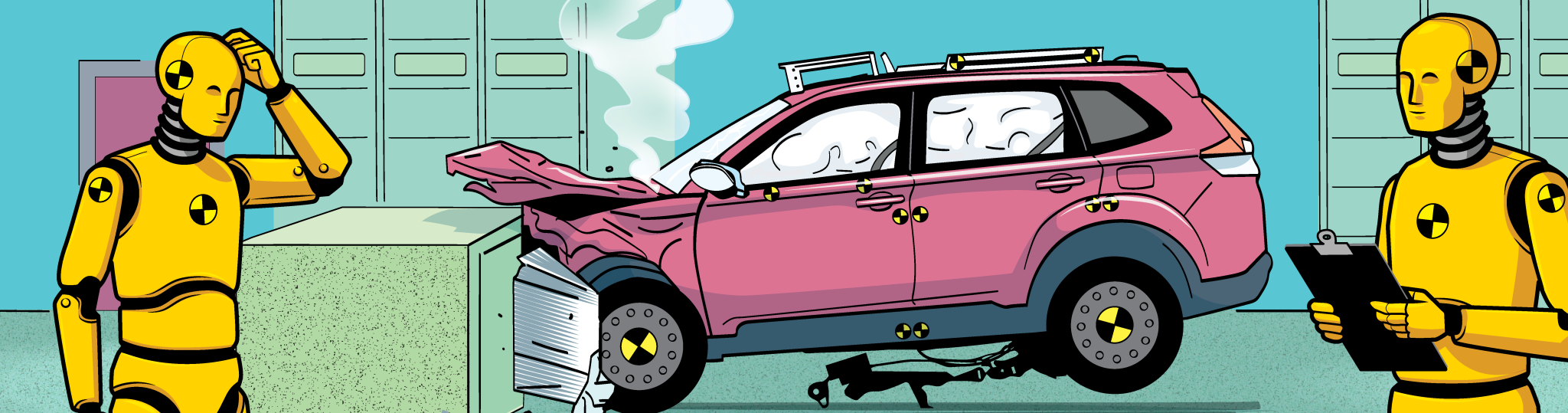
Even the best driver can get into an accident. And if it happens to you, you’re likely better off in a car that has been rated highly for safety.
Take, for instance, the test in which a car is rammed into a barrier, with the impact measured on a crash test dummy. “If we compare vehicles that get a Good rating in that test, which is the highest rating we hand out, versus a vehicle that gets a Poor rating, you’re 46 percent less likely to die in a frontal crash in those Good-rated vehicles,” says Joe Young of the nonprofit Insurance Institute for Highway Safety (IIHS), one of two entities that issue car safety ratings. The other safety-rating group is the National Highway Traffic Safety Administration (NHTSA), run by the U.S. Department of Transportation.

Crash Tests
By propelling cars into stationary barriers at up to 40 mph, or replicating side accidents by slamming weighed carts into cars, NHTSA and IIHS experts can study hundreds of impact factors, from how a steering column collapses and whether that harms the driver to the functional protection of airbags preventing head and neck injuries.
IIHS conducts two front-crash simulations:
• Small overlap, in which front-end sides of a car hit a barrier, for a total of 25 percent of that end colliding with a stationary object.
• Moderate overlap, in which 40 percent of the front of the car hits a barrier.
IIHS also conducts a side-impact test, plus a whiplash prevention test, to size up the force of being rear-ended.
NHTSA tests include a full-frontal crash (the entire bumper makes contact with a barrier), two kinds of side impacts (one meant to simulate hitting a telephone pole and another to mirror a T-bone collision from another car) and a rollover test.
Neither entity evaluates every car model; both test the highest-volume mass-market vehicles. Every year, IIHS tests about 200 of the more than 400 models marketed in the U.S., while NHTSA looks at about three dozen.
Crash Prevention Tech
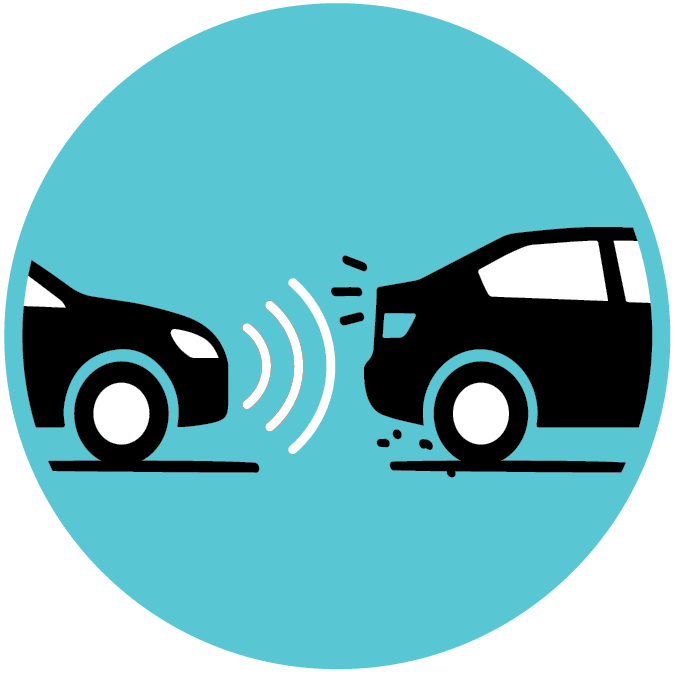
Both IIHS and NHTSA evaluate the “passive” safety features of a car, such as the metal structure surrounding the cabin, seat belts, airbags and head restraints. They also rate the effectiveness of “active” safety features, such as crash-avoidance technology.
A good example is what’s called automatic emergency braking (AEB), which can stop your car in case you fail to see that the motorist in front of you slammed on their brakes. IIHS data shows that AEB alone eliminates half of all front-to-rear crashes and can also lower your chance of being hurt in such an accident by reducing the impact speed.
“I’d encourage older drivers to consider a vehicle with good ratings for crash-prevention technology,” Young says. For example, IIHS says a system called rear automatic braking, which can prevent you from hitting another car while backing up, reduces accidents by up to 78 percent when paired with parking sensors and a rearview camera.

NHTSA Test Scores
NHTSA uses a scale of one to five stars, with five the safest. But the agency cautions not to compare vehicle ratings across classes—a large SUV versus a compact car, for example—because its tests are designed to simulate crashes of two vehicles of similar size and weight.

The IIHS System
There are four levels of IIHS ratings: Good, Acceptable, Marginal and Poor.
The best bunch of cars, roughly one-fifth of all tested models, earn its highest award, Top Safety Pick+. Those got Good ratings for all crash tests and also for IIHS’s updated front-crash prevention test. A second tier receives its Top Safety Pick award (without the plus). Those got Good crash test results. Both tiers have strong headlight ratings and effective pedestrian-avoidance technology. Young also cautions not to compare crash test ratings across classes. “In the real world, we know that a smaller car is going to be at a higher risk in a multi-vehicle crash.”
Michael Frank is an adjunct professor of journalism at SUNY New Paltz and a contributor to Consumer Reports, Men’s Journal, Gear Patrol and other outlets.